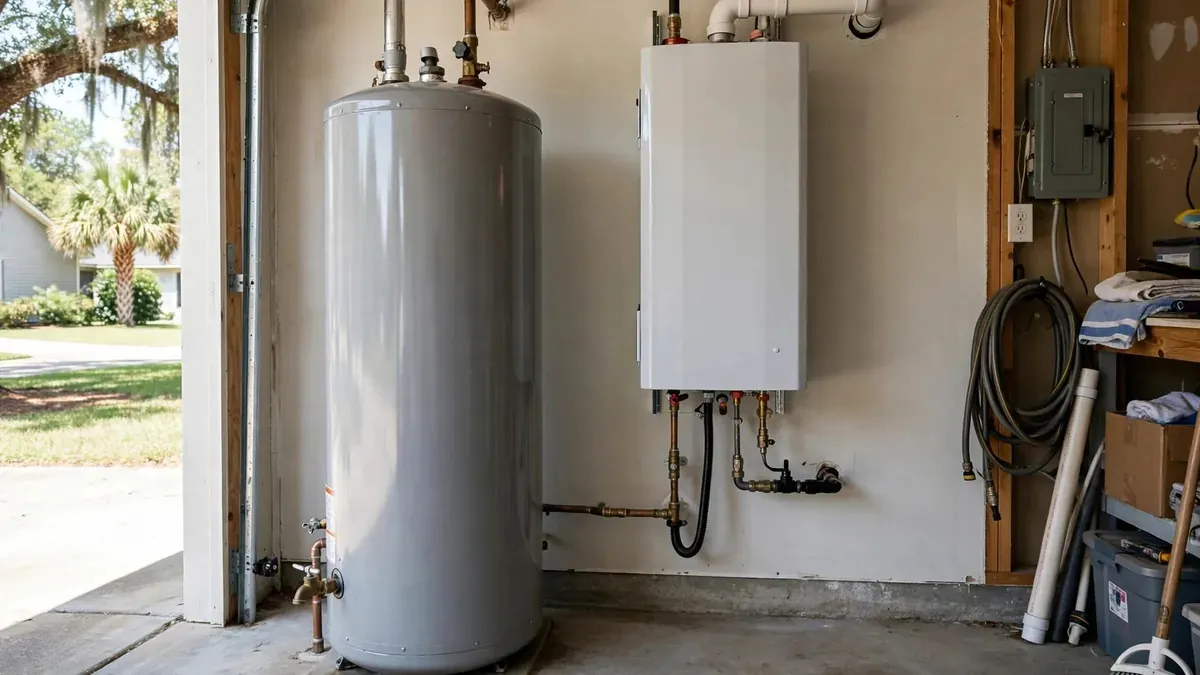
How on-demand heating works
When you open a hot tap, a flow sensor starts a gas burner or an electric element. Water passes through a heat exchanger and leaves hot. When you close the tap, the unit shuts down. There is no storage, which is why the supply is continuous and the size of the unit sets the limit.
Flow rate is the number that matters. A single unit has a maximum number of gallons per minute at a given temperature rise. If two showers and a dishwasher run together, it may not keep up, and you may need a larger unit or two.
Tankless versus a standard tank
| Tankless | Tank | |
|---|---|---|
| Hot water supply | Continuous, limited by flow rate | Limited by tank size |
| Installation | Often needs a bigger gas line and new venting | Usually a straight swap |
| Space | Mounts on a wall | Needs floor space |
| Maintenance | Descale on schedule | Flush periodically |
| Typical lifespan | Often longer | Roughly a decade |
The savings from tankless come from not heating stored water, and they depend on how you use hot water. A household that uses little hot water gains less.
What the installation involves
- A gas line large enough for the burner's peak demand.
- Sealed venting, usually plastic or stainless pipe, to the outdoors.
- A condensate drain for high-efficiency units.
- Electrical power for the controls and fan.
- Water shutoffs and service valves for flushing.
Older houses often need the gas line upsized and the vent rerouted. Our water heater installation page explains the code and permit side.
Gas supply and the Historic District
Bridgeton's Historic District covers about a quarter of the city and includes more than 2,000 properties. Some houses have a gas line sized for a stove and a small tank heater, or a masonry chimney that was never lined for modern appliances. We check yours. A tankless unit needs a much larger gas supply and a sealed vent, so both usually change.
Venting and gas sizing follow the manufacturer's installation standards and New Jersey's plumbing subcode (N.J.A.C. 5:23-3.15).
If you live in the district, ask the city whether exterior vent terminations or other visible changes trigger any review before you buy. Also ask the Bridgeton construction office about permit rules for a new gas appliance. We check the gas line and vent path during the quote, and tell you honestly if a tank fits your house better.
If you live in Vineland, where houses range from the 1860s grid to recent subdivisions, or in Millville, the answer depends on the house's gas line and vent path, not on the town.
When a tank is still the better choice
Tankless is not right for every house. If the gas line cannot be upsized economically, if venting is hard, or if the household uses very little hot water, a tank is cheaper to install and nearly as good. A tank is also forgiving of short-term spikes in demand.
If your current heater is a tank in good condition, there is no rush. When it fails, you will have time to price both options with real numbers, and water heater replacement covers what a straight swap involves.
What affects the cost
- The unit and its capacity. Larger flow rates cost more.
- Gas line and venting. These are often the biggest hidden costs.
- Electrical and condensate drain. Needed on many models.
- Water conditions. Scale means more flushing or a filter.
- Permit and inspection. Fees where they apply.
We give you a clear price before work starts. Call (856) 250-1784 with your current heater and fuel.
Sizing a tankless unit for your house
List every fixture that might run at the same time and add up their flow rates in gallons per minute. A shower uses a few gallons per minute, a dishwasher uses less, and a kitchen faucet falls in between. The temperature rise matters too. Cold groundwater in winter needs more heat than in summer.
A unit sized for summer can fall short in January. We size for the coldest incoming water, so the shower stays hot when you need it most.
Electric tankless: a different set of limits
Electric tankless units need a lot of amperage, often more than an older panel can spare. A whole-house electric unit may require a large dedicated circuit and a panel upgrade. For that reason, many homes use electric units only at a single sink or shower, or choose gas.
If you are considering electric, ask an electrician to check the panel before you buy. We coordinate with electricians when a new circuit is needed.
Flushing and long-term care
Minerals build up on the heat exchanger and cut flow, so plan on an annual flush, or more often if your water is hard. Check the manual, and keep the receipt for the warranty.
A tankless unit with a clogged inlet screen or a scaled exchanger throws error codes and can shut down. Regular care costs little and keeps the unit running for years.
Questions about this topic in Bridgeton
It depends on your hot water use and your gas line. Savings are real but not automatic.
Often yes. They burn a lot of gas at once, so the line is checked and sometimes upsized.
Often longer than a tank, with proper maintenance and descaling.
Usually, with new venting and sometimes a bigger gas line. We assess it first.
Not always, but hard water means more frequent flushing. Ask your water provider for its quality report.
A sealed vent usually exits through a wall or the roof, which can be visible. Ask the city whether exterior changes in the Historic District need review before you buy.
Most need electricity for controls and fans, so they do not run without power unless you have a backup.
Weighing tankless?
Call and ask whether your gas line and vent can support it.