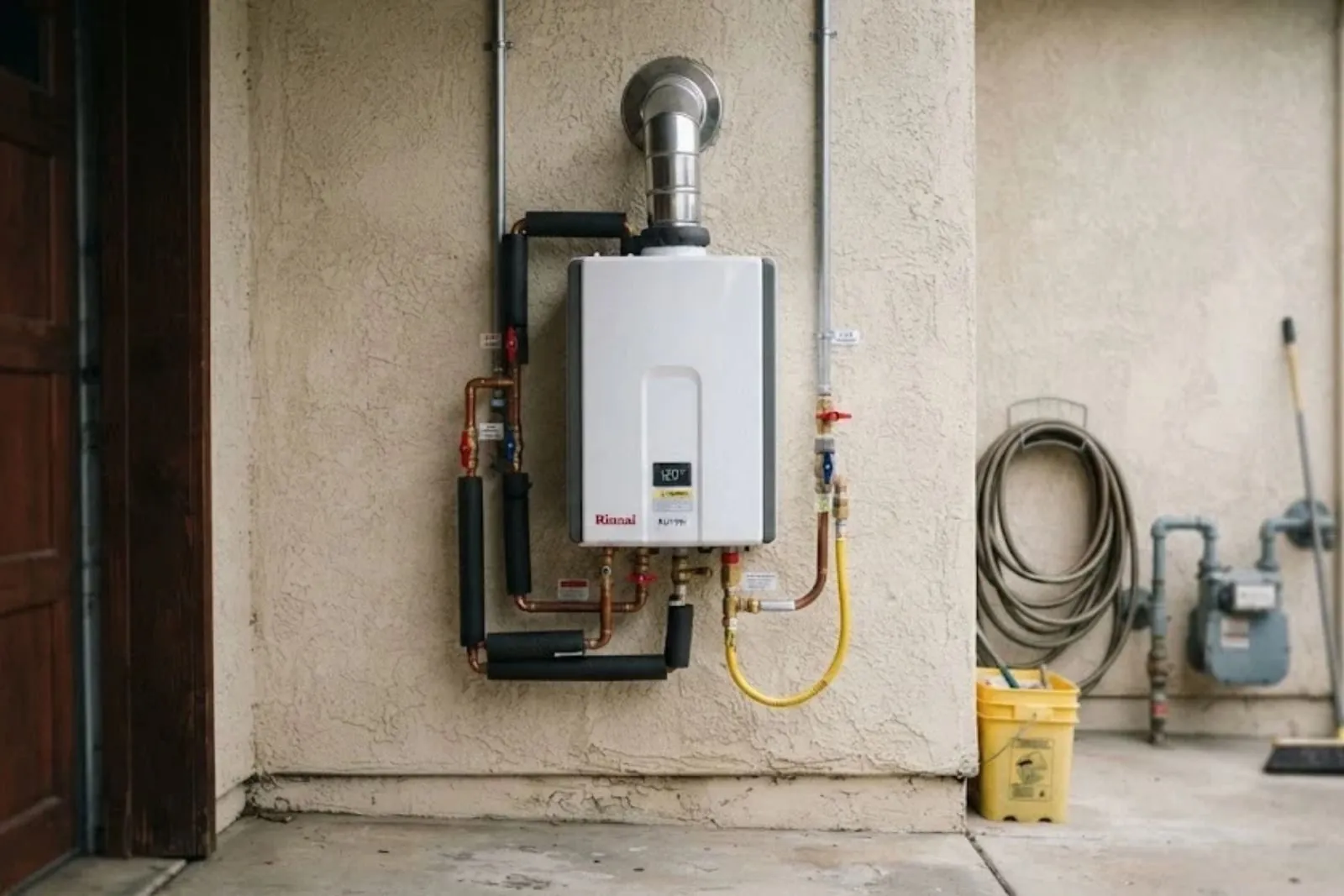
How a tankless heater works
When you open a hot tap, a flow sensor tells the unit to fire a gas burner or energize electric elements. Water passes through a heat exchanger and leaves hot. There is no tank to run out, but there is a limit on how many fixtures one unit can serve at once.
That limit is called the flow rate, and it is the first thing we size. An undersized unit gives lukewarm water when two showers run together.
Tankless or tank: an honest comparison
| Tankless | Standard tank | |
|---|---|---|
| Hot water supply | Continuous, limited by flow rate | Limited by tank size, then recovery |
| Space | Wall-mounted, small | Floor space and clearance |
| Up-front cost | Higher | Lower |
| Maintenance | Annual descaling recommended | Periodic tank flush |
| Typical lifespan | Often longer than a tank | Roughly a decade |
Neither is better for every home. A household with one bathroom and low demand may do fine with a tank. A large family with simultaneous use often benefits from tankless, if the gas line and vent can support it. See water heater replacement for tank options.
Why tankless units need flushing
Minerals in the water collect on the heat exchanger as scale. Scale cuts flow, raises the temperature the unit must work at and eventually triggers error codes. A flush circulates a descaling solution through the unit to dissolve it.
Hardness varies by water source, and we do not assume a figure for your address. Ask your water utility for its annual water quality report, or test the tap, and we adjust the flush interval to what you find.
Tankless unit acting up?
Give us the error code and we can narrow the cause.
Common tankless problems and fixes
- Error codes. Often point to venting, ignition, flow or temperature sensor trouble.
- Cold-water sandwich. A short burst of cold between two hot periods, usually a flow or settings issue.
- Low flow. Scale on the heat exchanger, a clogged inlet filter or partly closed valves.
- No ignition. Gas supply, igniter or flame sensor trouble.
- Leaks. Failed fittings or a cracked heat exchanger, which can mean replacement.
Repair makes sense on most of these. A cracked heat exchanger on an older unit may not be worth fixing.
Annual care that keeps a tankless unit healthy
- Flush with a descaling solution on the schedule the manual recommends.
- Clean the inlet water filter screen.
- Check the venting for blockage or loose joints.
- Test the unit for error codes and review them with the plumber.
- Keep the area around the unit clear of boxes and stored items.
A unit that is flushed on schedule runs more efficiently and fails less often. It also keeps the warranty valid, since many manufacturers require proof of maintenance.
Standards for venting and gas
Tankless units must be vented as the manufacturer specifies and installed to the plumbing subcode, N.J.A.C. 5:23-3.15, which adopts the National Standard Plumbing Code. Gas sizing and the electrical supply follow their own codes, including the National Electrical Code (NEC). We follow the manufacturer's instructions on clearances and exhaust.
What affects the price of tankless service
- Installation scope. Gas line upsizing, new vent runs and electrical needs drive cost.
- Unit capacity. Larger flow rates mean larger units.
- Water condition. Scale buildup means more frequent flushing and sometimes a filter.
- Repair part. Sensors cost less than a heat exchanger.
- Permits. Fees and inspection where they apply.
You get a clear price before work starts. Call (856) 250-1784 and describe the unit and the problem.
Installing a tankless unit in an older Bridgeton house
Some houses have a gas line sized for a stove and a small tank heater. A tankless unit draws a much larger burst, so the gas line may need upsizing. Venting is also different, since tankless exhaust uses sealed pipe rather than an old masonry chimney.
We check both before we quote. If the answer is that a tank is the better fit for your house, we say that. We also reach Vineland and Millville for tankless work.
Tankless Water Heater questions in Bridgeton, NJ
Manufacturers commonly recommend annual descaling, and harder water may call for more. Check your manual and the water report for your supply.
It does not run out the way a tank does, but it can fall short of demand if too many fixtures run at once.
Installation is generally permit-regulated in New Jersey, and details vary by municipality. Ask the Bridgeton construction office.
Codes vary by brand and model. Give us the code and brand and we can narrow the cause on the phone.
Often, yes. Tankless units draw a lot of gas at once. We check your line during the quote.
We work on most common brands. Tell us the model when you call so we can bring the right parts.
Need tankless install or repair?
Call to book in Bridgeton.