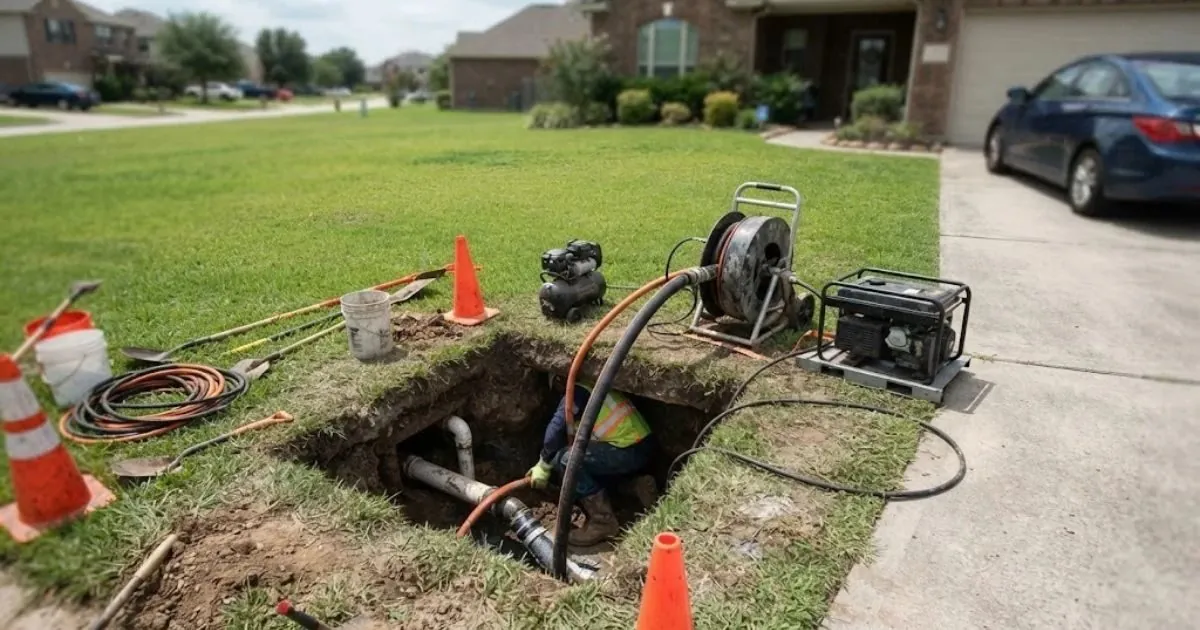
How the lining process works
- 1
Clean the pipe
The line is cleaned, often with jetting, so the liner bonds to the pipe wall.
- 2
Inspect with a camera
We confirm the pipe's condition and the length to be lined.
- 3
Prepare the liner
A felt or fiberglass tube is soaked in resin and sized for the pipe.
- 4
Pull and inflate
The liner is pulled in and inflated against the wall.
- 5
Cure
Steam, hot water or UV light hardens the resin.
- 6
Reopen lateral connections
Cutters restore branch connections and a final camera pass confirms the result.
When lining fits and when it does not
| Condition | Lining | Replacement |
|---|---|---|
| Cracks and open joints | Often a good fit | Not needed unless severe |
| Root intrusion at joints | Good, after roots are cut | Alternative |
| Collapsed pipe | Not suitable | Needed |
| Severe sag or belly | Does not fix the sag | Often needed |
| Offset joint | Depends on the offset | Often needed |
A liner follows the shape of the pipe, so a sag stays a sag. That is why a camera look comes first, and why our sewer line repair page covers all the options, not only lining.
Advantages and limits
- Less digging. Access pits replace a long trench.
- Faster. Many jobs finish in a day or two.
- Seals joints. It blocks root entry at seams.
- Slightly smaller pipe. The liner reduces the inside diameter a little.
- Not for every pipe. Collapse or severe offsets need other repairs.
Lining carries a long service life when done correctly on a suitable pipe. Ask for the manufacturer's warranty and the materials list, and make sure a camera pass is part of the work.
Old sewer laterals under Bridgeton's streets
Bridgeton was incorporated as a city in 1865, and its Historic District covers about a quarter of it. An older lateral may have joints that have shifted, and a camera shows whether yours has. Roots find open joints, and lining can seal them without digging up a brick sidewalk or a mature tree's root zone.
Liner products are tested to industry standards such as ASTM F1216, which covers cured-in-place lining, and permit rules fall under N.J.A.C. 5:23.
Responsibility for the lateral between the house and the public main depends on the municipality, so ask the Bridgeton construction office or your sewer authority where the boundary sits. Permit rules for replacing or lining sewer pipe also vary, and the same office can tell you what applies. Call 811 before any digging for access pits.
Millville became a city in 1866, so laterals there may be as old as Bridgeton's. See our Millville page, and our Vineland page for newer neighborhoods where plastic laterals are more common.
Spot lining versus full-length lining
If damage is at one point, a short sectional liner patches it. If joints leak along the whole run, a full-length liner is more practical. A sectional repair costs less but leaves other joints untouched, so the camera footage matters.
Ask whether the quote covers the whole line to the main or only part, and where the liner starts and ends. A repair that stops short of the connection leaves a weak point.
What affects the cost
- Length of the line. Longer lining costs more.
- Pipe diameter. Larger pipes need more material.
- Cleaning needs. A line with heavy roots or scale needs prep.
- Access. Pits or cleanout installation may be needed.
- Permits. Fees and inspections where they apply.
We give you a clear price before work starts. Insurance often excludes wear and tear on old lines, so ask your carrier. Call (856) 250-1784 for a camera visit.
Materials and curing methods
Liners come in felt and fiberglass, and resins are epoxy or polyester based. Curing happens with steam, hot water or ultraviolet light. Each method has its own strengths, and a good contractor can explain why they picked one for your pipe.
Ask about the liner's thickness, its rated lifespan and its compatibility with your pipe diameter and bends. A liner that is too thin may not meet code, and one that is too thick reduces flow more than necessary.
Warranty, inspection and paperwork
Get the warranty in writing, including what it covers and for how long. Ask who inspects the work and whether a post-lining camera pass is included. Request a copy of the video, since it is your record of the pipe's condition.
If you sell the house, the footage and the warranty are useful documents. A buyer's inspector may ask for them, and having them ready can ease negotiations.
Ask before you sign
Get the camera footage before and after, a written scope and the warranty terms. Ask whether the work is permit-regulated and who pulls the permit, and check the contractor's license with the state before work starts. A trenchless repair is still a significant job, and it deserves the same care as digging.
Questions about this topic in Bridgeton
On a pipe that is cracked but still round, it can be an excellent solution. On a collapsed or severely sagging pipe, replacement is the honest answer.
Many residential lines are lined in a day or two. Cleaning and access add time.
Slightly. The liner is thin, and most homes see no practical difference.
It may. Ask the Bridgeton construction office.
Yes. Cables and jetting are used on lined pipe, with the right equipment.
Start with a camera inspection. It shows the cracks, joints and shape of the pipe.
Cracked sewer pipe?
Start with a camera visit.