Find the source before spending money
| Source | Clue | Usual fix |
|---|---|---|
| Plumbing leak | Water near pipes, fixtures or the water heater | Repair the pipe, see leak detection |
| Condensation | Damp on cold pipes or walls in summer | Dehumidifier and insulation |
| Surface water | Water after rain along one wall | Gutters, grading and downspouts |
| Hydrostatic pressure | Seepage at the floor and wall joint | Interior drain and sump |
| Cracks in the wall or floor | Seeping or wet lines at a crack | Seal or inject the crack |
A pipe leak is the easiest to rule out, so we check it first. If the pipes test clean, the water is coming from outside.
Outside fixes that cost less
- Clean gutters and extend downspouts at least six feet from the foundation.
- Regrade soil so it slopes away from the house.
- Keep window wells clear and covered.
- Seal exposed cracks in the foundation wall.
- Check that outdoor hose bibs and irrigation do not leak near the house.
These steps fix a surprising number of damp basements. Try them before an interior system.
Interior drainage and pumps
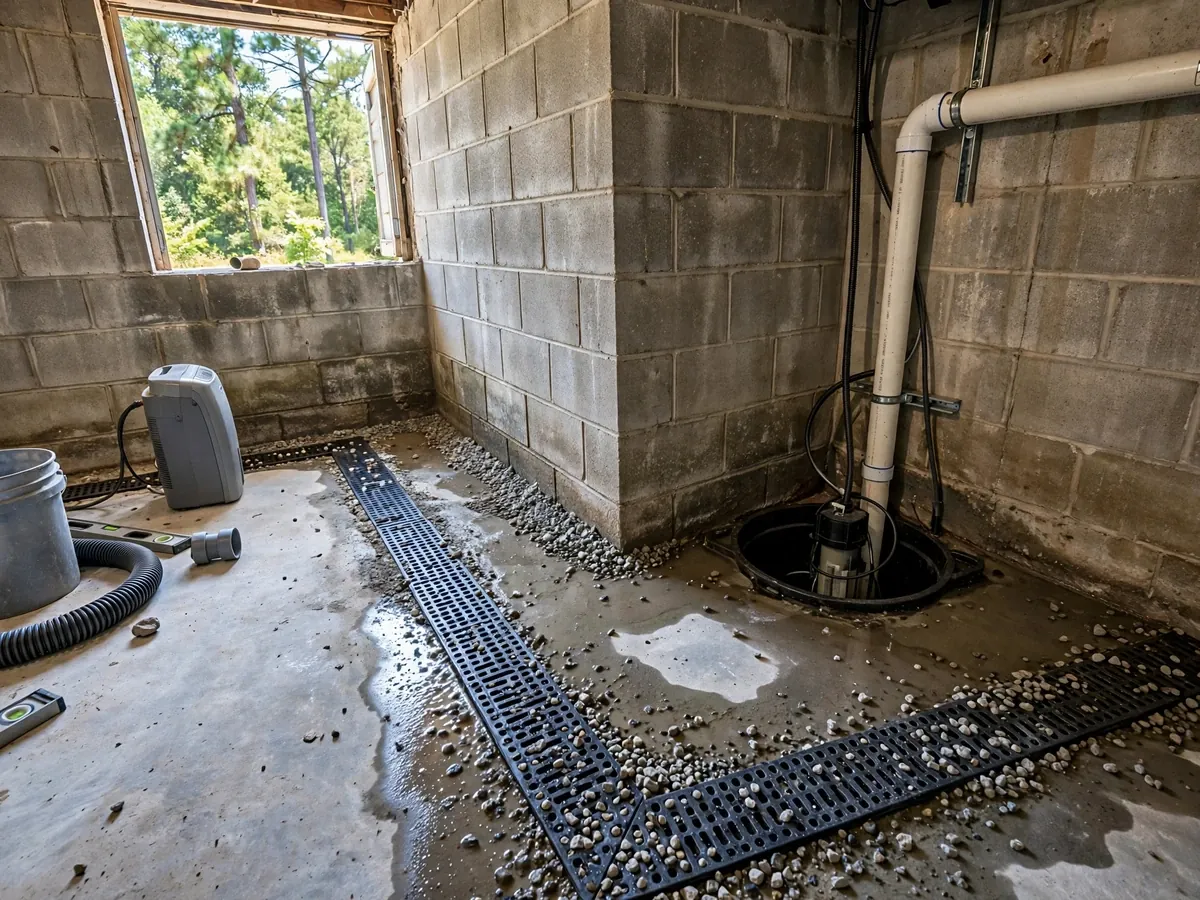
When groundwater pushes through the floor-wall joint, an interior drain channels water to a sump pit, and a pump moves it out. This lets water in and manages it, rather than blocking it from outside. It is common, effective and less disruptive than excavation.
Exterior waterproofing means digging down the foundation wall, sealing it and adding drainage. It is the most thorough and the most costly, and it is rarely the first choice.
Wet basement problem?
We start by finding the source.
What happens on a waterproofing visit
- 1
Walk the basement and the outside
We look for staining, efflorescence, cracks and the way water moves around the house.
- 2
Rule out plumbing
Pipes and the water heater are checked and the meter tested.
- 3
Recommend the least invasive fix
Drainage, gutters and cracks first, interior systems next.
- 4
Quote in writing
You get a clear price before work starts.
Questions to ask any waterproofing contractor
- Where exactly is the water entering, and how did you confirm it?
- Did you rule out plumbing leaks and condensation first?
- What happens to the water once it is collected, and where does the pump discharge?
- What does the warranty cover, and who honors it if the company closes?
- Is there a cheaper outside fix, like gutters and grading, to try first?
A contractor who cannot answer the first question is guessing. Take photos of the wet areas after a rain, since they help anyone who comes to look at the basement.
Mold, humidity and finished basements
Moisture that stays for weeks lets mold grow on drywall, carpet and stored boxes. Stopping the water comes first, and removing damaged material comes next. A dehumidifier helps control humidity in a basement that is dry but musty, and it is a cheap test of whether the problem is groundwater or air.
Codes that touch basement work
Interior drains and sump discharge are governed by the plumbing subcode, N.J.A.C. 5:23-3.15, which adopts the National Standard Plumbing Code, and by local rules on stormwater. Wiring for a pump follows the National Electrical Code (NEC). Ask the Bridgeton construction office what applies before work starts.
What affects the price of basement waterproofing
- Cause of the water. Gutters cost little. Interior drains cost more.
- Linear feet of drain. Longer runs mean more work.
- Sump pump and backup. Equipment adds cost.
- Wall and floor condition. Cracks and old foundations need care.
- Finishes. Finished basements add demolition and restoration.
Waterproofing is a significant investment, so get more than one opinion. Call (856) 250-1784 for ours.
Wet basements near the Cohansey River
Bridgeton sits along the Cohansey River in a flat part of South Jersey. We do not claim a specific water table figure for your street, since conditions vary block by block. What we can do is look at your basement and tell you what the signs mean.
Stone, brick and block foundations behave differently from poured concrete, so the right system depends on what we find when we look.
Basement Waterproofing questions in Bridgeton, NJ
Drainage, sump pumps and pipe leaks are. Structural work such as foundation repair belongs to a contractor, and we say so when it applies.
Tape a square of plastic wrap to the wall for a day. Moisture on the room side is condensation, and on the wall side is seepage.
Not always. A basement that only seeps after heavy rain may be fixed by gutters and grading.
It removes the moisture mold needs, but existing mold needs separate cleanup.
Excavation and plumbing connections may require a permit. Ask the Bridgeton construction office.
Many policies exclude groundwater seepage. Check yours before you rely on it.
Need basement water managed?
Call to book in Bridgeton.